
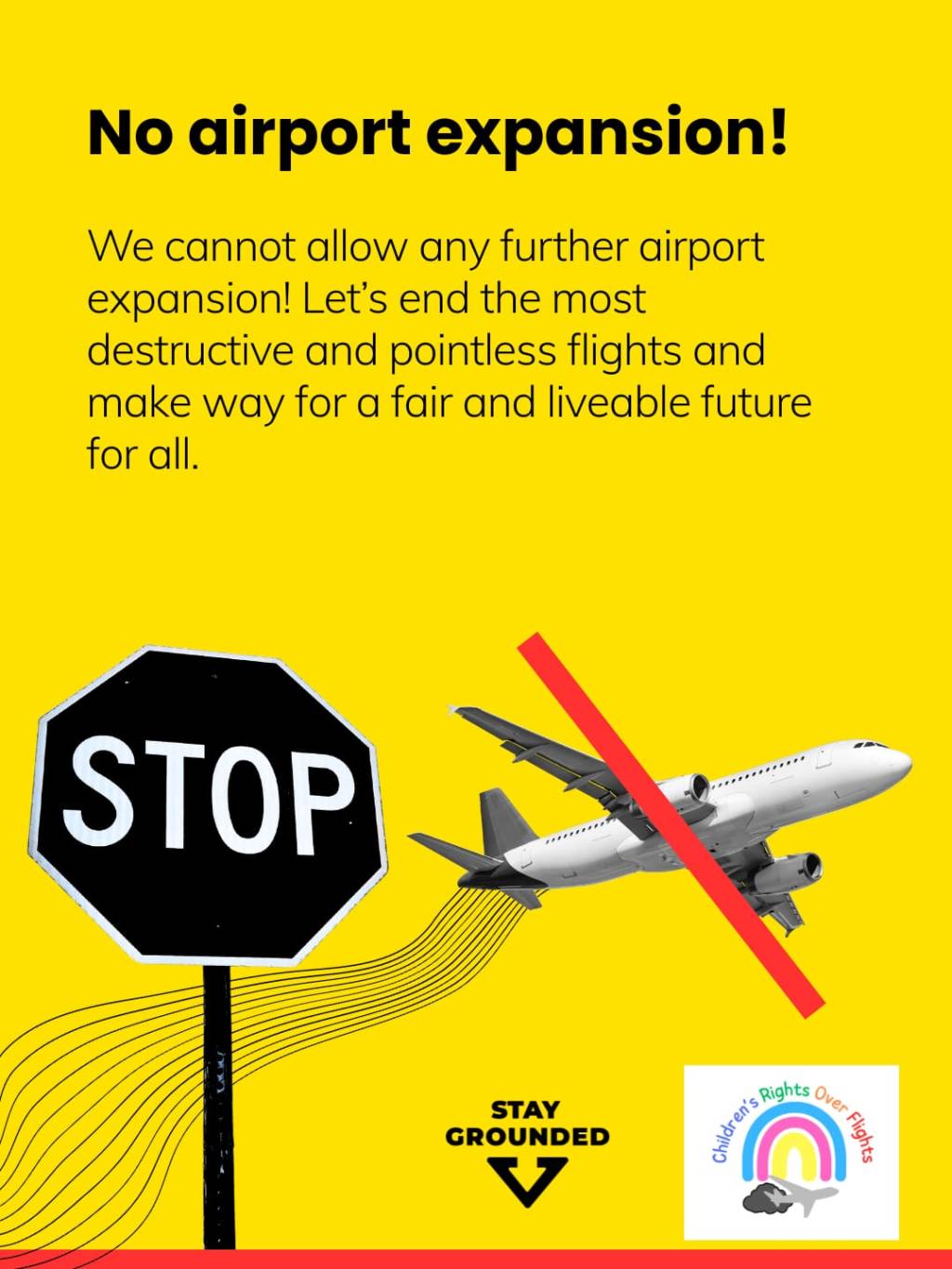
- 95+ groups across 25 countries have responded to the jet fuel crisis with a manifesto proposing ten measures to reduce air traffic.
- The manifesto highlights aviation’s impacts, from climate heating to militarisation.
- Stay Grounded described the jet fuel crisis as the “new normal” in an era of war and climate instability.
29th April 2026 – More than 95 groups, including Friends of the Earth International, Scientist Rebellion and Ireland’s Children’s Rights Over Flights, today launched a manifesto demanding a sharp reduction in aviation to halt climate collapse. The manifesto, “A Red Line for Airports”, signed by groups from 25 countries worldwide and coordinated by the Stay Grounded network, calls out the aviation sector as a core part of the current “fossil-fuelled” system and a direct obstacle to a decent future. It proposes ten measures to stop airport expansion and reduce air traffic, leading a transformation “grounded in justice and planetary boundaries.”
For Stay Grounded, the current jet fuel crisis – driven by geopolitical tensions, supply chain disruptions and volatile fossil fuel markets – exposes the fragility of the aviation sector. As airlines face rising costs and uncertainty, the situation highlights how dependent aviation remains on finite fossil fuels. The network believes this reflects a broader pattern of a sector highly vulnerable to global shocks and long-term instability.
The manifesto includes ten “safety measures” such as stopping all new airport expansion projects, establishing a ban on private jets and night flights, setting strict carbon caps on airports included in national emission budgets and guaranteeing a just transition for workers in the sector.
The groups state that the only effective solution is to reduce flights – measures such as offsets or so-called ‘sustainable’ aviation fuels are rejected as greenwashing designed to justify continued growth.
In Ireland, there are plans to expand the largest two airports – Dublin and Cork – and also Waterford airport. Since 2007, Dublin Airport has been subject to a limitation on expansion via a “cap” of 32 million annual passengers, but this limit has been exceeded in recent years and efforts to enforce it have been legally challenged by airlines.
Raising Dublin Airport’s annual passenger cap from 32 to 40 million, as the Airport Authority has applied to do, would lead to flight traffic pollution increasing by 22% by 2031, even as climate change and the outlook for our kids worsens. Lifting the cap altogether would allow even higher passenger numbers, increasing pollution from the airport’s flight activities even more.
Recently, the Government has prepared legislation allowing the Minister for Transport to scrap the passenger cap and prevent such a limit being put in place in the future. The outline legislation includes text exempting it from the Climate Act. At a recent hearing on the legislation, environmental and legal groups including Friends of the Earth (FoE), An Taisce and Opportunity Green expressed alarm at this, with Mr McEvilly of FoE stating “The only reasonable interpretation [of seeking to exempt it] is that the Government is aware that removing the passenger cap is likely to be inconsistent with climate obligations.”.
Elaine Baker, County Tipperary, a member of Children’s Rights Over Flights said, “There is no way of reducing the climate impact of aviation without substantially reducing the number of planes in the air. We have to think, as a society, what is a fair and just way of doing that. Expanding airports is the exact opposite.”
Celestine O’Reilly, a member of Children’s Rights Over Flights living in Dublin said, “We are told because Ireland is an island we must fly. We have always been an island; but since 1990 while our population has increased by 44%, emissions from flights have increased by 500%.”
Inês Teles, spokesperson from the Stay Grounded Network, said: “The jet fuel crisis shows what the “new normal” looks like. In a world shaped by war, rising extremism and accelerating climate breakdown, dependence on fossil fuels means permanent instability. Aviation makes this clear: it is one of the fastest-growing sources of emissions, and one of the most vulnerable sectors to global shocks. The solution is simple: reduce flights and invest in grounded alternatives.”
Peter Kalmus, climate scientist and subscriber to the manifesto, said: “The alarm has been sounding for decades, but we are still locked into a system addicted to fossil fuels. The consequences are clear: war, famine, inequality, instability and worsening climate disasters year after year. Aviation is one of the most unnecessary and unequal sectors: 80% of the world population has never flown, while 1% is responsible for 50% of emissions. It’s past time we cut it – we can do so by design, or be forced to by disaster.”
The Stay Grounded network is inviting organisations and individuals worldwide to sign and endorse the manifesto “A Red Line for Airports”, adding to a growing international coalition calling for a halt to airport expansion and a reduction in air traffic. The manifesto is open for signatures from civil society groups, grassroots organisations and members of the public.
-END-


Comments